Fridges

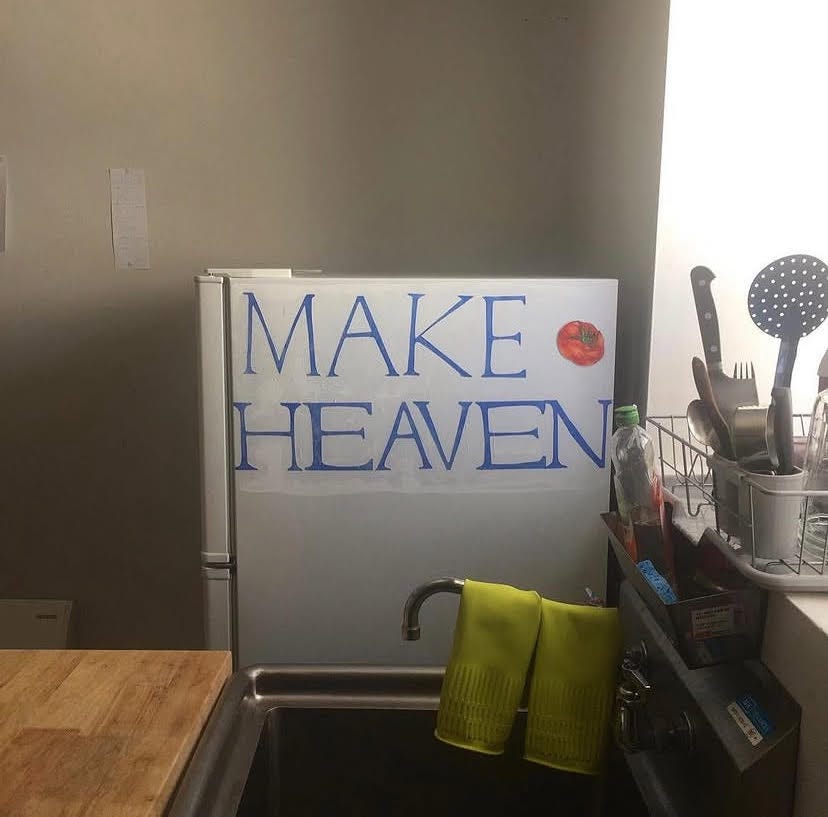
It turns out that the crisper box at the bottom of a refrigerator is actually quite expensive. I’m not sure how much it costs, but I was given instructions to take the whole crisper out of the fridge when I go to prepare a meal for my PCA “consumer” (that’s the official title, because I can’t say client or patient; I am neither her private chef nor her nurse). The crisper broke before I started working with her, the plastic broke which was inconvenient, it stopped being able to slide in and out of place. So I always take this new crisper box out and put it on a chair beside the fridge to look at all the vegetables. Fennel, garlic scapes, scallions, cilantro, parsley, dill, hakuri turnips, carrots, beets, kale.
The kale I wash in a bowl. I pull the greens from the stems in a gentle downwards motion. The greens float to the top of the water when I try to soak them. Then I lift them and drain them in a colander, sometimes I wash them multiple times especially if it has rained recently. If it has rained recently, the rain bounces off the ground around the kale plant and coats the leaves in mud. If it’s been excessively hot recently, that means the farmers were harvesting in the excessive heat. The kale documents the heat by wilting. No matter how wilted, the greens will perk back up when placed in cold water.
I put the clean kale on a cutting board. Curly kale especially has a feathery, weightless quality beneath my hand. I pressed all the greens down to cut them, it is like holding down a helium balloon. While pressing with my left hand, I guided the dull knife with my right and cut longitudes, ribbons, one after the other as close together as I could get them. Then I gathered each of these ribbons up and cut them a few times the other way, latitudinally I guess I’d say. It’s so hard to write about cooking.
With these last cuts, I could hear how dull my knife was. I was pressing through many layers of leaves at this point. I heard the incisions meekly tear, I heard the edges of each new division bruise. A bruised green is briefly even more verdant than an unharmed one. Bruised kale becomes aromatic. Something you may not know is that a field full of kale smells like kale, especially on a hot morning. Each plant is damaged just by each day spent living. Neither here nor there I heard a voice on the radio recently say that the moment a pianist presses a piano key, the sound begins to degrade. Only she didn’t say degrade, she said a word like degrade that surprised me, decompose, spoil, maybe I’ll think of it. Anyway it seems to me that just by living, the kale is bruised, or otherwise muddied, bitten, cooked, or torn. And each way it is affected by touch and temperature creates a perfume. I wonder what distance kale perfume could travel. If the wind came and there were no obstacles. Just walking through any cultivated city in spring, there’s lilacs “in the air.”
You know, if you were focused on something like kale’s aroma, you might go about looking at the refrigerator as the aroma’s enemy. Like a cryogenic hostel preserving a body at the moment of death, the fridge dampens the kale’s essence and proliferates a fragrance that smells much more like fridge.
Access to cold storage is so new, in the grand scheme it has only just happened. A man named Fredric “Ice King” Tudor schemed to sell ice around the world. His intention with the ice was to create cold conditions for food, not storage conditions. I think the distinction is important. A piece of cold fruit was a form of luxury. Imagine that instead of yourself now, you are a girl two hundred years ago. You are a fancy girl, so even though it’s a hot summer, some servant hands you a cold peach. It’s a long feverish day and now there’s this cold juicy sweet thing in your hand, now on your tongue. You see, the context of this particular cold does not suppress the fruit’s sensuality. I write this to illustrate the power of changing a purpose within a system. It is not the cold itself in my consumer’s fridge that removes the damaged-life quality of the kale, it is that the purpose of the cold is to pause the plant’s decomposition, to store the pause. Like silence.
Storage, I’m learning, is a war-time activity.
At the end of the eighteenth century, the French introduced universal conscription to raise the largest army the world had yet seen: more than a million men, under the command of a young, ambitious Napoleon Bonaparte. The local countryside buckled under the pressure of feeding this plundering horde, and in 1795 the French government issued a challenge: a generous cash prize of twelve thousand francs for a new method of preserving food. 1
Which is how Nicolas Appert came to invent canning. And the fridge, as a stasis technique, was invented in 1913, and became an object of mass production in 1918. The years it took this fridge invention to become widely reproducible are the same years as the first world war.
I have heard that the world ended then, in the beginning of the twentieth century. I heard this from my boyfriend who said it randomly in bed one night. Half asleep, I took him literally. So we are all ghosts? I asked. In a way, he replied.
What’s frightening to me about ghosts is that they are held in suspension. I get claustrophobic for them, seeing them stuck still in place and time. Nothing is meant to last forever, and eternity would be awfully boring if I was frozen and not allowed to change.
When I pressed my left hand down on the pillowy pages of kale, and then triumphantly made one final gesture with my knife, this is the point I’ve been getting to… in that moment, maybe it was a coincidence, maybe it was the crucifer “in the air,” somehow I felt replete with love. It is a grand arc, this meal stuff. It is a grand, resplendent, fading arc. This is a great song, the entropy of a single note.
Nicola Twilley, Frostbite